Fast Converter · Conversions
OBJ to GLB — prepare a model for 3D viewing
Convert a static OBJ model to GLB for tools and viewers that support glTF 2.0. Your source files stay on your computer.
Windows 10 / 11 · Installed Blender required · Local processing
When to choose this format
OBJ stores geometry separately from material descriptions and images. GLB is easier to share as a single file. This is useful for static objects, but conversion does not automatically produce an optimized web asset.
How to convert
- Install Fast Converter and Blender. Select the installed Blender folder in the Blender field.
- Select OBJ input and add your files with their linked resources available.
- Choose GLB output. Open export settings and enable the options you need.
- Choose a separate output folder and click Convert. Open the result in the destination application after processing.
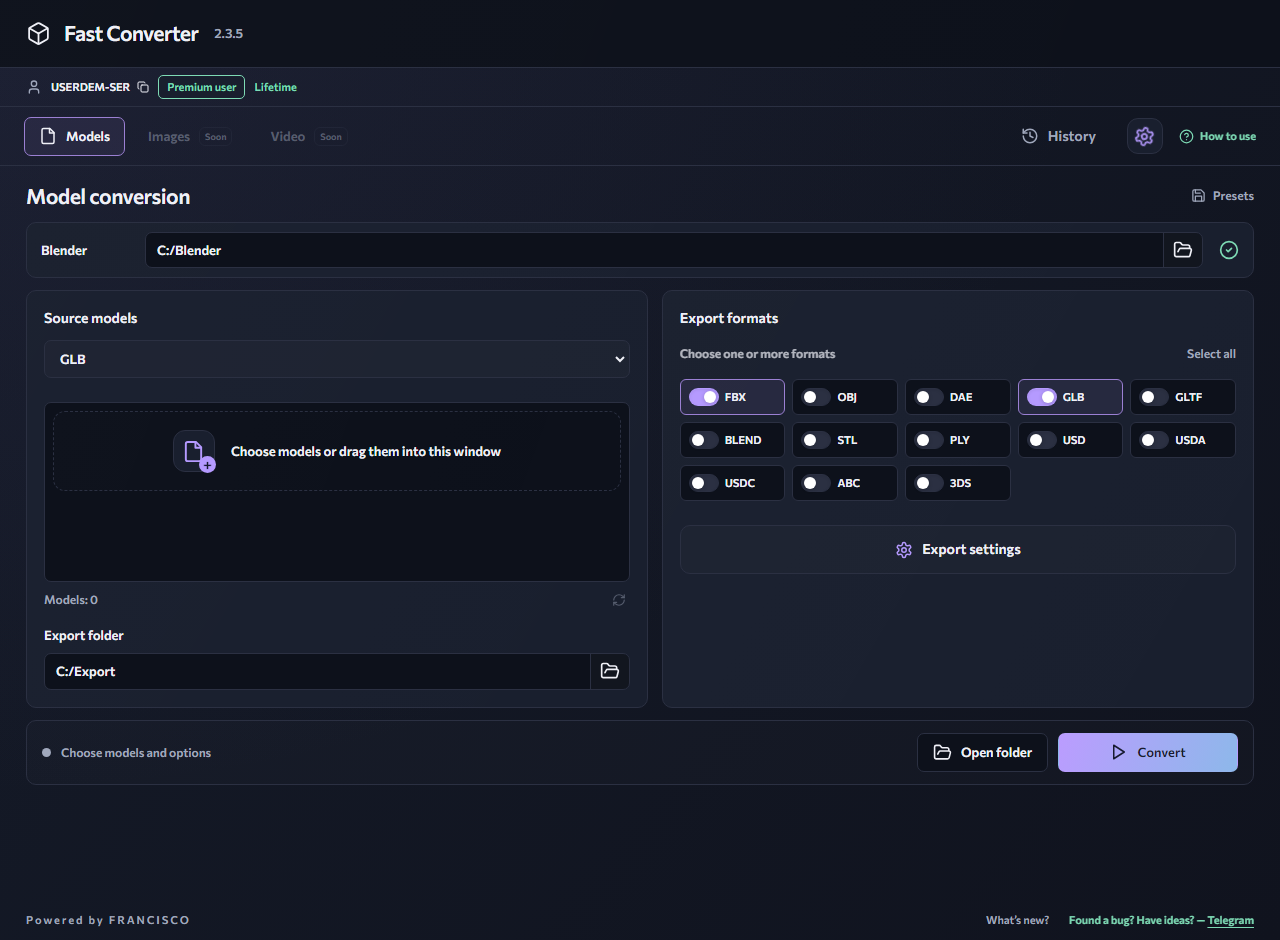
Export settings
Keep the OBJ, its MTL and images together with their relative paths intact. Select GLB and enable Textures. Choosing GLB cannot recover image files that are missing from the source.
What to keep in mind
MTL parameters do not map perfectly to glTF materials. Check color, transparency and surface highlights after conversion. OBJ has no skeletal animation; conversion cannot invent a rig or motion that the source does not contain.
Check the result
Check the GLB in its destination viewer. For a website, review file size, polygon count and texture resolution. Simplify the model if needed, then export it again.
Available in the free version
Process multiple models of one input format and choose one output format per run. Free input formats: GLB, GLTF, FBX, OBJ and BLEND. Free outputs: FBX, OBJ, DAE, GLB, GLTF and BLEND. Mixed inputs, multiple outputs, advanced formats, model preview, LOD removal and ungrouping require Premium.
A small verified example
We checked this workflow with a simple textured cube using the Fast Converter conversion script and Blender 4.0. This verifies a basic scenario; it does not guarantee compatibility with every model, material or rig.
Download source and result (ZIP)Common questions
Do I upload my model to the website?
No. Install the Windows application: conversion runs on your computer using Blender. The website provides an interactive interface demonstration.
Can I convert multiple files for free?
Yes: add multiple models of one supported input format and choose one supported output format. Mixed input batches and multiple output formats require Premium.
Related reading
GLTF to GLB — package your 3D model
Convert a glTF asset with external resources to GLB for easier sharing and use in 3D viewers. Processing runs on your own computer.
FBX → GLBHow to convert FBX to GLB
Save an FBX asset as GLB for a viewer or project that supports glTF 2.0. Prepare the images referenced by the FBX before converting a textured scene.
BLEND → GLBHow to convert BLEND to GLB
Prepare a GLB from a Blender project for sharing or viewing in glTF tools. Conversion uses the saved state of the project.
GuidesHow to batch-convert 3D models
Batch conversion removes repeated setup: choose an input format, add your models, configure export and start processing.
GuidesWhy textures go missing after conversion
A gray or pink model does not necessarily mean its geometry was lost. Check the source images, their paths and the output format’s capabilities first.
Windows 10 / 11 · Installed Blender required · Local processing